
Lesson #9: Even If You’re Fluent, You’re Still Not

by Annie on March 29, 2011

This is a guest post by Jessica Spiegel: the wonderful, all-knowing Italy expert behind BootsnAll’s WhyGoItaly.

After taking time out of his busy day to give me a tour of the hostel in Venice he managed, my host offered to give me a mini-walking tour of the neighborhood surrounding the hostel. It was a kind offer, and one I couldn’t refuse, although he’d already gone out of his way to show me every nook and cranny of the old building the hostel occupied.

I followed him up and down the stairs of the former granary, the February chill penetrating the concrete walls and magnifying the fact that the hostel was nearly empty of guests, taking snapshots of rooms and jotting notes in my book. We wound our way in a circular fashion – up the stairs on one side of the huge building and down the stairs on the other – to end up where we’d left off, in the main hall. I thought my visit was complete. It had already taken more time than the other hotel visits I’d done, where managers didn’t have time for grand tours, and I was ready for a nap. Or an espresso break. Or both.

That’s when my host offered his guided walking tour of the neighborhood, and when my inability to be curt or bitchy with people who are being nice to me kicked in. So off we went on a slow-paced walk around the island, pausing occasionally while he gestured toward a building and said… Something.

It’s here that I should mention something critical: my host was speaking not in Italian, but in the Venetian dialect, and to this day I’ve no earthly idea what he was saying for most of the two hours I spent with him. In fact, I’m only guessing that it was a tour of the neighborhood he was offering, since when I got on a vaporetto nearly two hours later that’s what it felt like I’d gotten. But who knows? Maybe when we left the hostel he was asking if I’d like to go get some lunch, or meet his pet parrot, or take a ride in a speedboat. All I know is that like Ginger Rogers, I let someone else lead – and so we walked, slowly, through the deserted streets around the hostel for the next hour and a half, him chattering away and me nodding at regular intervals.
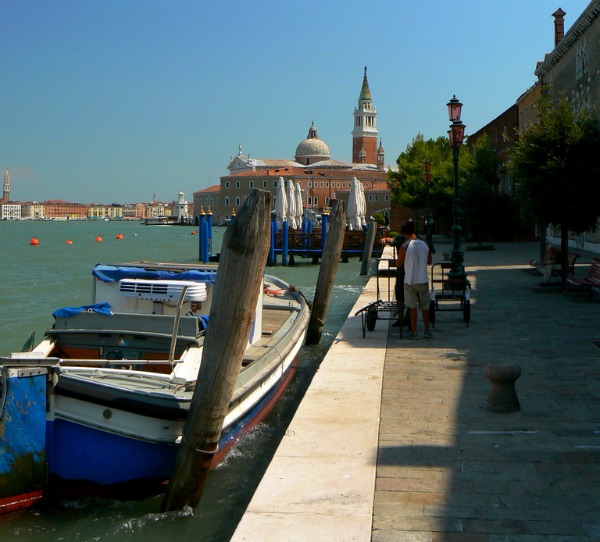
In some ways, it’s my fault. I like to think that I can hold my own in Italian and that, while nowhere near fluent, I can usually get the drift of what’s being said enough to understand even if I can’t quite contribute. I’ve been involved in conversations about travel, food, Italian composers, politics, and religion – and in some of them I even contributed my fair share. The problem is that Italians are a trusting bunch, and once you get past a simple “buongiorno” without stumbling they fawn all over you with “Oh, you speak Italian so well” nonsense and proceed to prattle on in their native tongue, dropped consonants and slang thrown in for good measure.

When I speak to someone whose native language isn’t English, I slow down. I enunciate. I try not to use contractions as much. I skip the heavy slang. I don’t raise my voice, like those stereotypes we all love to hate, but until I’m confident my conversation partner is fluent enough to keep up I try to go easy on the stuff that makes comprehension so hard. But Italians? They don’t have this compassionate gene. Even if you say “Non parlo bene l’italiano,” as long as you’ve said it with a decent accent they’re full steam ahead with the rapid-fire slang-infused Italian.

This brings us to the most confusing element of conversing in Italy – the dialects. Perhaps you’ve been preparing for this trip, studying Italian once a week at the local community college, doing your verb drills, listening to a Pimsleur CD on your commute. In some places, this work will serve you well – you’ll order meals in Italian, get the customary “Oh, you speak Italian so well,” and feel wonderful about it. In other places, you’ll feel like you studied entirely the wrong language – or flew to entirely the wrong country.

Italian dialects are more numerous than you can imagine – they say people who live a few kilometers apart may have different words for the same thing – and in some cases they’re full-blown other languages. Sometimes they sound a bit like Italian, sometimes they sound very much like Italian, and sometimes they sound like Arabic. When I’d been told to meet a guy at that Venice hostel for a tour, I didn’t assume we’d be speaking English, but I did assume – foolishly – that we’d be speaking Italian. Walking through the hostel, I asked questions in Italian and he answered them in Italian, but as soon as the tour was over he slipped back into his dialect, and I was utterly left behind.

I’m moderately comforted by the fact that there are full-blooded Italians who have lived in the country their entire lives who can’t understand the dialects of people in other parts of Italy, but this doesn’t change the fact that I’ll never know what my genial and chatty host was trying to tell me as I followed him around a small island of Venice for hours. It does tell us that while the Italians may not care enough about whether we understand them to slow down or avoid slang, they are a supremely generous bunch. I’ve no idea what my host was saying, but I’ll never forget our walk around Venice.

photo by Nick Bramhall

About the Author: Jessica Spiegel is a Portland-based travel writer for indie travel guide BootsnAll, for whom she writes an online travel guide to Italy. She’s always happy to help travelers find what they need, from cheap flights to hostels to train tickets – and if she doesn’t know the answer, she’ll know who to ask.

Related Posts Plugin for WordPress, Blogger...
  • http://twitter.com/brad5patterson Brad Patterson

    Fun read.

    I lived in italy for about a year and ran headfirst into this issue too. Can be frustrating if you’re sitting at a dinner table for hours not understanding, can’t it!

    All the same, I love languages and it’s the beauty of the rainbow.

    I spent 3 years in China, and the dialects there are unheard of… wild differences. Really different languages. Just came back from a month in a single dialect area. By the end I was able to make jokes in the dialect, but it takes a ton of attention when you understand very little.

    Thanks again for sharing.

    Cheers, Brad

  • http://waywardtraveller.com/ Annie

    I can definitely relate to you and Jessica here. I didn’t speak a word of Italian when I got here so now I consider myself pretty good (I get by) but when I travel anywhere else (especially Sardinia!!) it was like a whole new language!

    I know what you mean I get a lot of compliments for speaking Italian as an American, especially in Florence, because there are so many Americans here that don’t speak or even try to speak it.

  • http://www.venicekayak.com/ René Seindal, Venice Kayak

    The Italian dialects are not dialects at all. They are languages which have by the Italian unification been reduced to regional languages. Venice for an independent state for a thousand years before Italy was concocted, and their language was that, a language and not a dialect of something that would only appear later in time. Veneto, Sicilian, Tuscan, Neapolitan are all the original, native languages, and Italian the artificial latercomer which has been imposed on everybody through school, military service, radio and tv.

    Most Italians I know are bilingual. Their first language is the regional language spoken in the family and with friends, and the second is Italian which they learn from childhood. The two languages are related, so the split is not profound, and most Italians most of the time speak some intermediary form between the two, shifting back and forth according to the situation.

    One particular friend of mine here in Venice speaks Italian at work, and with me mostly, but with friends and family he shifts towards Venetian, and also if he’s very tired or drunk :-) He probably never really speaks either, but at times it might be 90-10 Italian-Venetian, and at other times 10-90 Italian Venetian.

    The older the person the stronger the shift towards the regional language, because the elder generation have been going less to school and were less exposed to national mass media in their youth.

    The younger and better educated the person is, the stronger the shift towards Italian.

    This is really what makes is difficult for us foreigners. We’re not confronted with one or even two different languages, but with the entire scale between the two extremes, and communication is very fluid, causing people to shift up and down the scale between Italian and regional language constantly, from sentence to sentence, even from word to word.

    The locals have no problems, because they’re bilingual, but for the rest of us learning two languages fluently enough to mix them with ease is another issue.

  • http://www.groundedtraveler.com Andrew

    Cool article. I remember sitting in a language school in Bologna thinking I understood the language tapes from the book that they were playing us. That idea you mention, Jessica, of speaking slowly and attempting to enunciate. That is until they played us a piece from Modena. Nope, nothing. Well I got a few words and could tell it was a type of Italian, but no clue what he was saying.

    Germany has its regional dialects too. They can be this extreme. In small towns it is far worse. I have heard stories of small town teachers being unable (or simply unwilling) to teach in anything other than dialect. This makes it near impossible for foreign born children who learn german from their parents who learned it at school to understand. The bigger the city the fewer problems with it. Though even in my apartment building there is a woman who speaks with enough accent to be hard to understand. Education and media have extended deep enough that a lot of young people speak German and English instead of German and Dialect. They can understand it, but not speak more than a few sentences.
    This all varies by region too. I had a roommate from Schwabenland who spoke fine High German, but when his girlfriend came to visit I understood nothing. And she wasn’t even speaking in dialect.
    Even in southwest Germany here the language is fairly understandable. If you slip over the border into Switzerland it is unintelligible. Swiss German is another language like your Venetian. And it is so common that asking a question in high German will result in an answer more likely in English than German.
    Languages are cool. Thanks for the look into Italian.

  • Fede Dav

    dialects are not as common as they used to be .For instance many young people from north to south don’t even know any dialect, except for some words. Anyway Jessica has made a fair point. It’s true english native always talk slowly and enunciate clearly when they speak with non native speakers of the language whereas Italians don’t. That’ s very true. I think that is because, at leas unconsciously they like to see the other person strive (since they too find it hard to understand foreign languages as all foreign production on Italian tv are dubbed into Italian). It may just be me but I’m quite sure that is the main reason. Maybe it’s just st inconscious but I bet it does play a role

  • Pingback: Italy Travel News 03/31/2011 | Italy Travel Guide

  • http://waywardtraveller.com/ Annie

    When I was in Sardinia, we talked about this a lot actually because my friends speak Italian (with a little bit of a vernacular) but they were telling us how their grandparents only speak “Sardo”, which is the Sardinian language.

    It’s all very interesting the way that language works!

  • http://waywardtraveller.com/ Annie

    I have noticed that if I let an Italian know that I speak and understand a bit of Italian that they will completely take off and it’s like they don’t know how to speak slowly.

    When I get comfortable speaking with someone (for example my boyfriend) in English I have a hard time speaking slowly and enunciating clearly. I get really frustrated when he doesn’t understand but then again I have to put myself in his shoes and imagine if he was speaking to me fast in Italian!

  • Stefania

    Hi all!
    I am from Italy and the explanation made by Rene is great, I couldn’t say it better.
    Anyway, every country has its dialects (I am now been living in Newcastle, UK, and Geordie is terrible!) and most of people have difficulties in walking in foreign people’s shoes, even more if they have never been abroad. I have worked in an International customer service and German and French people never slowed down even if you asked.
    I think Italians rarely slow down or avoid slang because most of them aren’t accustomed in speaking foreign languages, so they often don’t recognise “standard words” from “difficult words”. As an Italian not understanding all dialects but just the most common or nearest ones, I think the main problem are not slang words, but the way people pronounce it and their accent, which often confuses and mislead. I am from Milan and understanding “Sardo” (which is anyway considered another language by linguists) and “Siciliano”.

Previous post:

Next post: